Plant cell
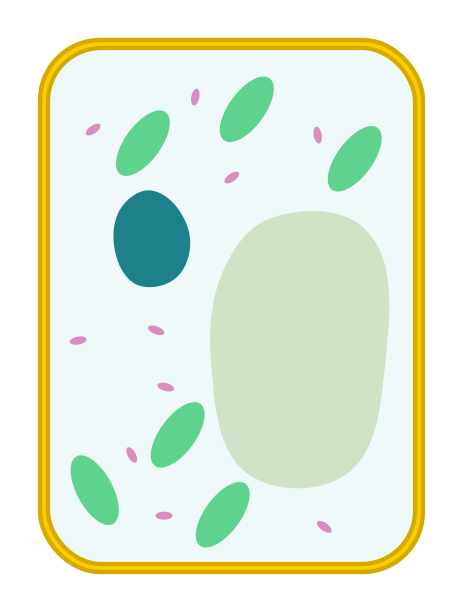
All plants are made of cells. Under a microscope, a plant cell shows a cell wall, cytoplasm, a nucleus, a vacuole and green chloroplasts.
The numbers on the picture mark the parts of the cell. Tap a number or a name to see a short summary, or go through all the parts with the "Step by step" button.

Parts
1. Cell wall
The strong outer layer of a plant cell. Its main building material is cellulose. Cotton fibers, for example, are made of this substance. Animal cells do not have a cell wall.
- What it does
- protects the cell
- gives the cell its shape and strength
- lets water and substances dissolved in it pass through
2. Cell membrane
A thin film under the cell wall. It surrounds the cytoplasm. The membrane lets some substances into and out of the cell and holds back others.
- What it does
- separates the cytoplasm from the cell wall
- controls which substances go into and out of the cell
3. Cytoplasm
A thick, jelly-like substance inside the cell. The nucleus and the other parts of the cell are found in it. Many of the cell's life processes take place in the cytoplasm.
- What it does
- fills the cell
- connects the parts of the cell
- many of the cell's life processes take place in it
4. Nucleus
One of the most noticeable parts of the cell. The nucleus holds the hereditary material: information about how the cell is built and how it lives, which is passed on to new cells. Bacteria have no nucleus.
- What it does
- controls the life of the cell
- holds the hereditary material
- takes part in cell division
Learn more: Bacteria
5. Vacuole
A large sac inside the cell filled with cell sap. Cell sap is water with substances dissolved in it. In older plant cells the vacuole can be very large and take up almost the whole cell.
- What it does
- stores water and dissolved substances
- when full of sap, helps the cell keep its shape
6. Chloroplasts
Green bodies in the cytoplasm, one kind of plastid. They contain a green substance called chlorophyll. In chloroplasts, food is made using light: this is photosynthesis.
- What it does
- give the plant its green color
- make food using light (photosynthesis)
- release oxygen during photosynthesis
Learn more: Plants
7. Mitochondria
Small bodies in the cytoplasm. In them, oxygen is used to release the energy the cell needs from food. Plant, animal and fungal cells all have mitochondria.
- What it does
- give the cell energy
- use oxygen to do this: this is how the cell breathes
Sources
- Encyclopaedia Britannica, Cell wall
- Encyclopaedia Britannica, Cellulose
- Encyclopaedia Britannica, Cell membrane
- Encyclopaedia Britannica, Cytoplasm
- Encyclopaedia Britannica, Nucleus
- Encyclopaedia Britannica, Vacuole
- Encyclopaedia Britannica, Plant cell
- Encyclopaedia Britannica, Chloroplast
- Encyclopaedia Britannica, Mitochondrion
- Encyclopaedia Britannica, Cellular respiration